
Mouse spider
Scotophaeus blackwalli
Name means: “its hairy grey-brown body looks like a tiny mouse”

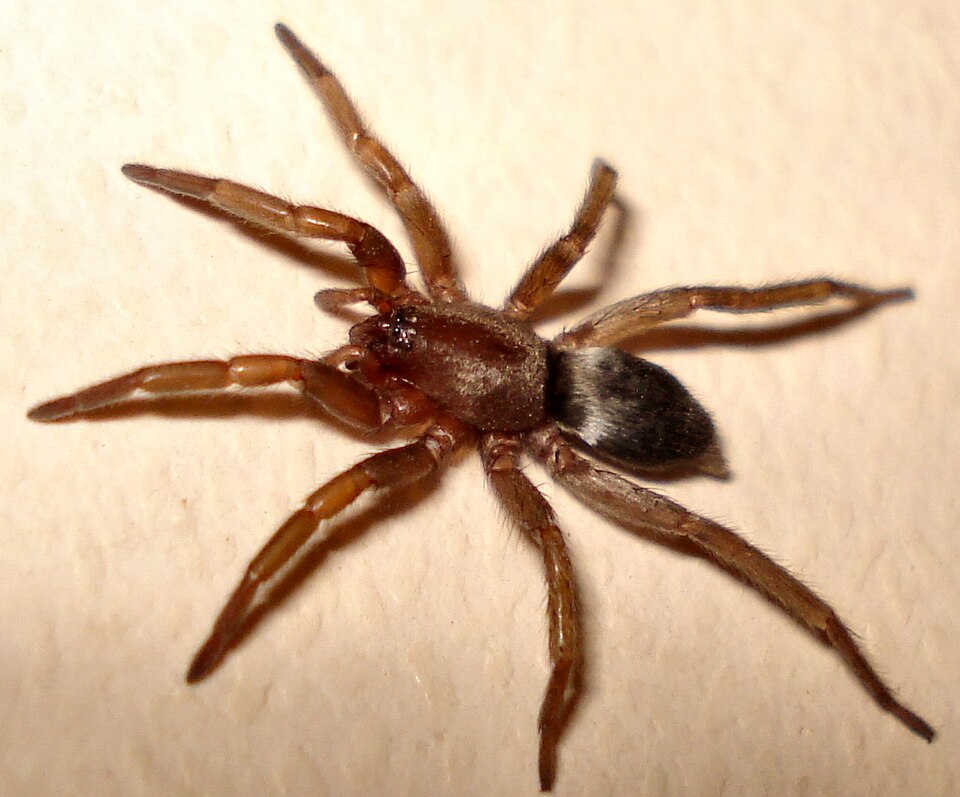
The mouse spider is a dark brown and grey spider covered in soft hairs that make it look like a tiny mouse. It does not build a web. At night it creeps around and hunts insects and other spiders.
Fun fact: spiders are not insects. Insects have six legs, spiders have eight. Everyone calls them bugs anyway!
Lives in
Europe, Turkey and Iran, now also North America, Peru and Hawaii, often in houses
Length
0.9 to 1.2 cm (0.35 to 0.47 in)
What does it eat?
It hunts insects and other spiders at night and also eats dead things it finds.
How big is it?
How long is it?
🍚as long as 2 grains of rice in a row🍽️could run across a dinner table in 2.8 seconds⚡moves 30 times its own body length every second
How big is Mouse spider compared to YOU?
Just maths in your browser. Nothing is saved or sent anywhere.
How fast is it?
A tortoise about 0.3 km/h (0.19 mph)
Mouse spider about 1.3 km/h (0.81 mph)
A person walking about 5 km/h (3.1 mph)
A kid running fast about 13 km/h (8.1 mph)
cool stuff
Fun facts
1
It ties up its prey with sticky silk from its big spinnerets at the back of its body.
2
Females make silk nests to keep their eggs safe.
3
In Britain it is often found in and around houses in autumn.
4
In warmer parts of Europe it hides under tree bark and in holes in walls.
you asked
Most asked questions about Mouse spider
?Why is it called the mouse spider?
Its grey-brown hairy body looks like a tiny mouse.
For bug experts
- Scientific name
- Scotophaeus blackwalli
- Group
- Spiders
- Family
- Gnaphosidae
- Classification
- Arachnida > Araneae > Gnaphosidae
- Lives on
- Europe, Asia, North America, South America, Australia and Oceania
Where the facts come from
- Scotophaeus blackwalli (Wikipedia, CC BY-SA 4.0): what it looks like, where it lives, what it eats, sizes and fun facts, retold in simple words.
- Picture by Mick E. Talbot. CC BY 2.0, Wikimedia Commons. The sticker of this bug is drawn from this picture.
If we got something wrong, sorry, we are bug fans, not a science journal. Tell us at [email protected] and we will fix it.
Bug Wiki honey jar For grown-ups: Bug Wiki is free, with no ads and no tracking. A small tip helps keep it online.Leave a tip European garden spider
 Goliath birdeater
 Brown recluse
 Redback spider
 Yellow garden spider
 Bold jumping spider
 Common furniture beetle
 Wheat weevil
 Blue-eyed ensign wasp
 Smoky brown cockroach
 Confused flour beetle
 House pseudoscorpion