

St Mark's fly
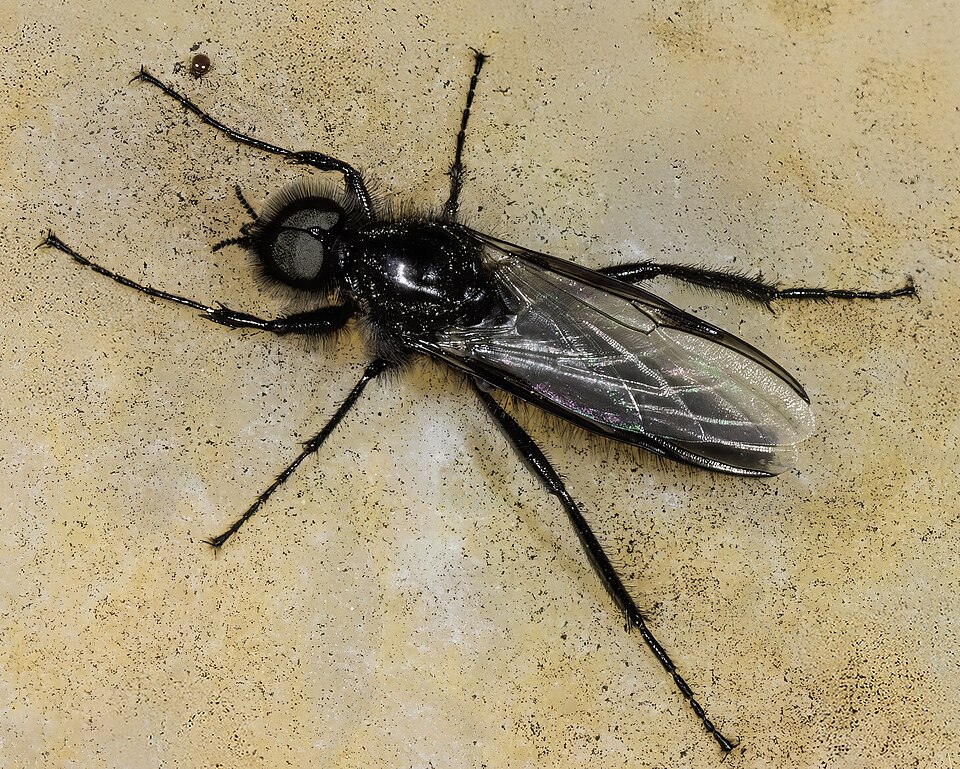
St Mark's fly is a shiny black, hairy fly that appears in spring. It flies slowly with its long legs dangling down underneath, like a tiny helicopter with its landing gear out. Big groups of them drift lazily over meadows and hedges.
How big is it?
How long is it?
How big is St Mark's fly compared to YOU?
Just maths in your browser. Nothing is saved or sent anywhere.
How fast is it?
Fun facts
The males have huge eyes that touch on top of the head. The females have small eyes far apart on the sides.
It helps flowers by carrying pollen, just like bees do.
The wind often blows these flies onto rivers and lakes, where trout love to snap them up.
Anglers make pretend St Mark's flies with long dangly legs to catch fish.
Its larvae help turn dead leaves into new soil.
Most asked questions about St Mark's fly
?Do St Mark's flies bite?
No. They cannot pierce skin, do not sting and are completely harmless to people.
?When do St Mark's flies come out?
In late April and May. They are named after St Mark's Day on 25 April.
?What do St Mark's flies eat?
The adults drink nectar and eat pollen from blossoms. The larvae eat dead leaves and roots in the soil.
For bug experts
- Scientific name
- Bibio marci
- Named by
- Linnaeus, 1758
- Group
- Flies and mosquitoes
- Family
- Bibionidae
- Classification
- Insecta > Diptera > Bibionidae
- Lives on
- Europe
- Also known as
- Hawthorn fly
Where the facts come from
- Bibio marci (Wikipedia, CC BY-SA 4.0): what it looks like, where it lives, what it eats, sizes and fun facts, retold in simple words.
- Picture by Didier Descouens. CC BY-SA 4.0, Wikimedia Commons. The round sticker of this bug is cut from the same picture.
If we got something wrong, sorry, we are bug fans, not a science journal. Tell us at [email protected] and we will fix it.
 Housefly
 New World screwworm fly
 Lovebug
 Tsetse fly
 Common fruit fly
 Asian tiger mosquito
 Dock bug
 Anise swallowtail
 Small elephant hawk-moth
 Leopard moth
 Marbled white
 Black oil beetle
_Bibio_marci.jpg)