

Vestal cuckoo bumblebee
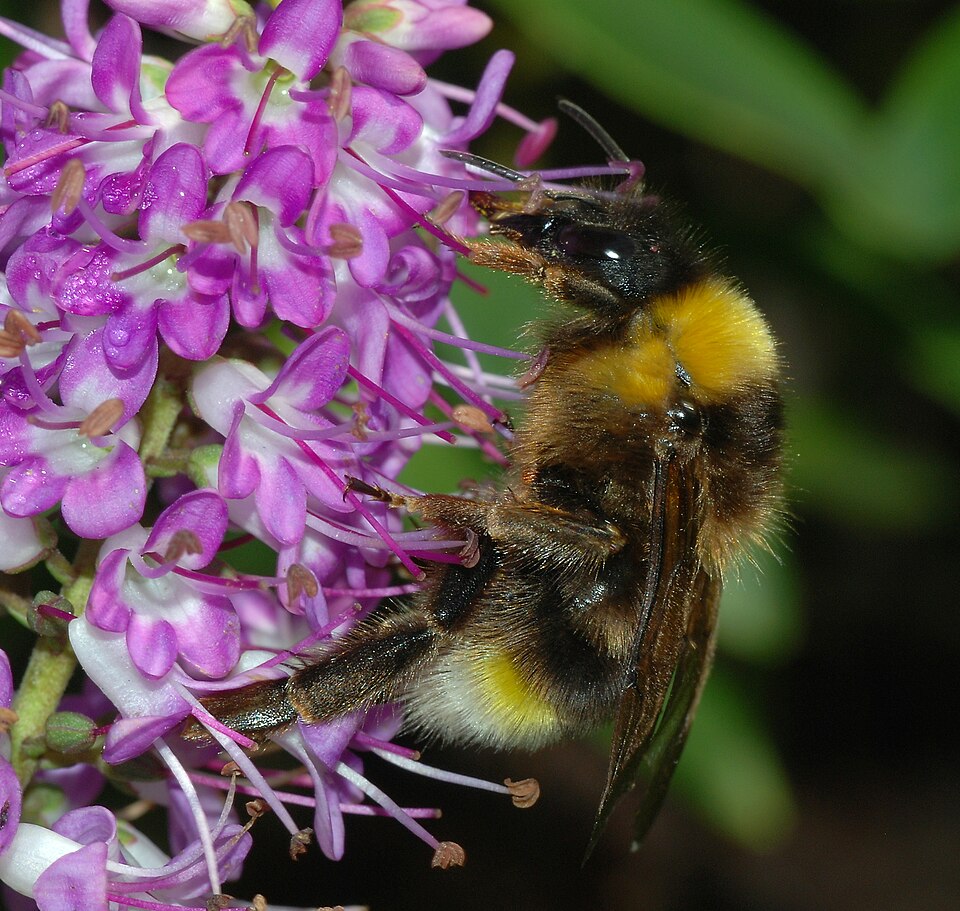
The vestal cuckoo bumblebee is a big black bumblebee with an orange collar and a white tail. Like a cuckoo bird, it does not raise its own babies. The female sneaks into the nest of a buff-tailed bumblebee, takes over, and lets the workers there look after her young.
How fast is it?
Fun facts
It has no pollen baskets on its legs, because it never collects pollen for its babies.
The female can be 21 millimetres long, while the male is smaller at about 16 millimetres.
Taking over a nest is slow work: it takes almost a month.
In Ireland people thought it was gone, but in 2014 it was found again in a walled garden in Dublin.
Some orchids smell like a female bee, and the boy bees visit them by mistake and carry their pollen.
Most asked questions about Vestal cuckoo bumblebee
?What is a cuckoo bumblebee?
It is a bumblebee that does not build its own nest. It takes over another bumblebee's nest and lets those workers raise its young.
?What does the vestal cuckoo bumblebee eat?
It drinks nectar from flowers like clover, dandelions and knapweed.
For bug experts
- Scientific name
- Bombus vestalis
- Group
- Bees and bumblebees
- Family
- Apidae
- Classification
- Insecta > Hymenoptera > Apidae
- Lives on
- Europe, Africa, Asia
Where the facts come from
- Bombus vestalis (Wikipedia, CC BY-SA 4.0): what it looks like, where it lives, what it eats, sizes and fun facts, retold in simple words.
- Picture by Alvesgaspar. CC BY-SA 3.0, Wikimedia Commons. The round sticker of this bug is cut from the same picture.
If we got something wrong, sorry, we are bug fans, not a science journal. Tell us at [email protected] and we will fix it.
 Western honey bee
 Buff-tailed bumblebee
 Violet carpenter bee
 Giant honey bee
 Wallace's giant bee
 Himalayan giant honey bee
 Narrow-winged tree cricket
 Mazarine blue
 Spring field cricket
 Soybean aphid
 Dark green fritillary
 Hedgehog tick