
Double-spined dolly ant
Dolichoderus doriae

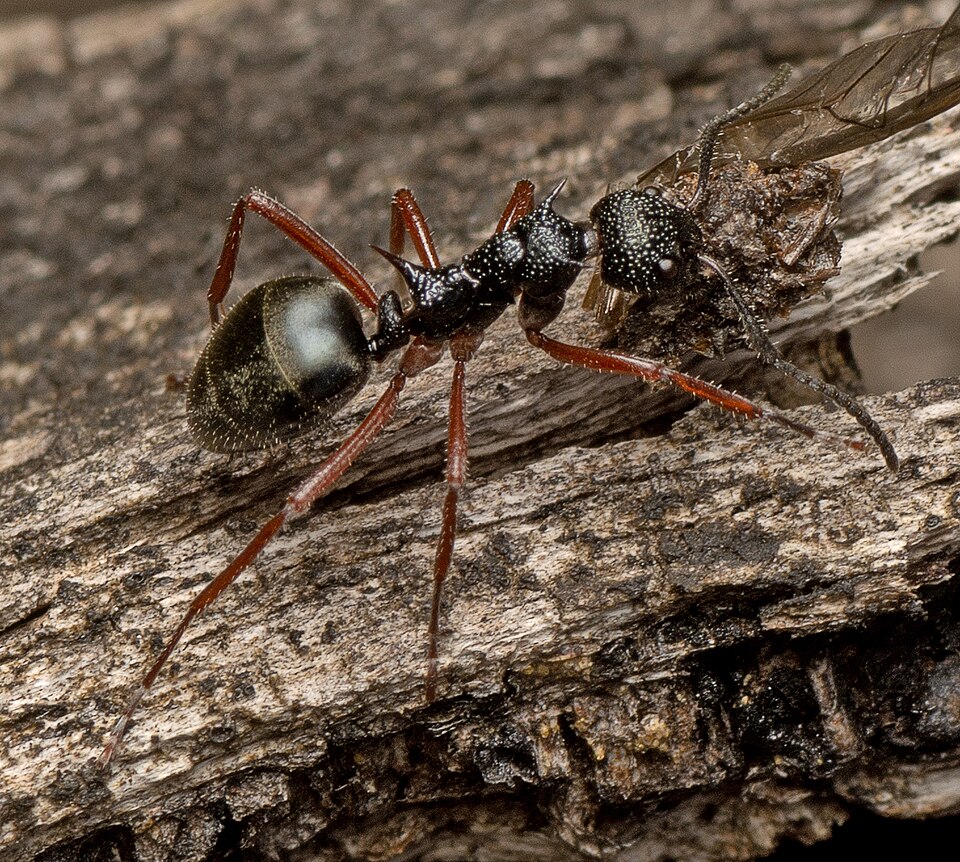
The double-spined dolly ant is an Australian ant that lives in thick forests. It makes its home in the soil, under stones or in rotten wood. On warm days the workers do something odd: they cuddle up with their babies in balls on the ground.
Lives in
Southeastern Australia, in forests of New South Wales, the Australian Capital Territory and Victoria
What does it eat?
It searches for food along trails on the ground and up tree trunks.
How fast is it?
A garden snail about 0.05 km/h (0.03 mph)
A tortoise about 0.3 km/h (0.19 mph)
Double-spined dolly ant about 0.3 km/h (0.19 mph)
A person walking about 5 km/h (3.1 mph)
cool stuff
Fun facts
1
In warm weather the workers and their young gather together in balls on the ground.
2
It walks in long trails on the ground and up tree trunks when it looks for food.
3
It nests in the soil, along the edges of stones and fallen branches, or in rotten wood at the bottom of trees.
you asked
Most asked questions about Double-spined dolly ant
?Where does the double-spined dolly ant live?
In thick forests in southeastern Australia, in New South Wales, the Australian Capital Territory and Victoria.
For bug experts
- Scientific name
- Dolichoderus doriae
- Named by
- Emery, 1887
- Group
- Ants
- Family
- Formicidae
- Classification
- Insecta > Hymenoptera > Formicidae
- Lives on
- Australia and Oceania
Where the facts come from
- Dolichoderus doriae (Wikipedia, CC BY-SA 4.0): what it looks like, where it lives, what it eats, sizes and fun facts, retold in simple words.
- Picture by tjeales. CC BY-SA 4.0, Wikimedia Commons. The sticker of this bug is drawn from this picture.
If we got something wrong, sorry, we are bug fans, not a science journal. Tell us at [email protected] and we will fix it.
Bug Wiki honey jar For grown-ups: Bug Wiki is free, with no ads and no tracking. A small tip helps keep it online.Leave a tip Black garden ant
 Bullet ant
 Pharaoh ant
 Argentine ant
 Red imported fire ant
 Yellow crazy ant
 Striped oak bug
 Yellow velvet beetle
 Changeable mantleslug
 Tree damsel bug
 One-spotted variant
 Yellow-spotted longicorn beetle