
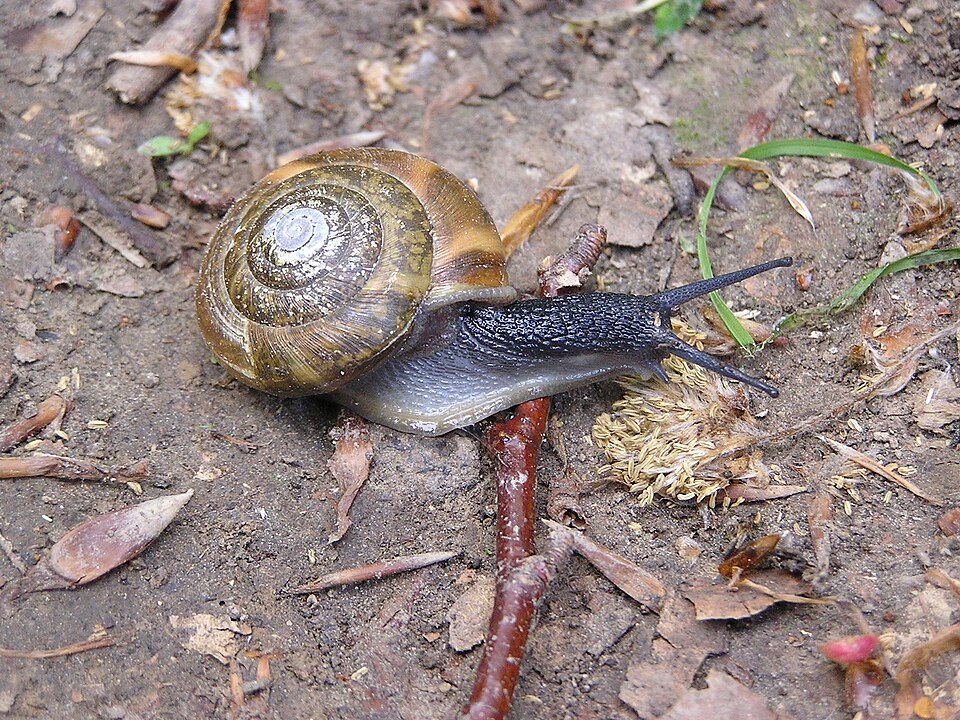
Large glass snail
Aegopis verticillus
Eats: A bit of everythingSnails, slugs and wormsForests and woodsNo legsNot an insect, but a bug cousin

The large glass snail is a land snail from Europe. It belongs to a family called the true glass snails. Like other land snails, it breathes air and carries its home on its back.
Fun fact: this one is not an insect at all, it has no legs! But kids find it on every bug hunt, so it lives in Bug Wiki too.
Lives in
Central and southern Europe, from Italy and the Alps to Serbia
Can it hurt you?
Harmless
Harmless. Wash your hands after holding one, like after touching any wild animal.
What does it eat?
Like other land snails, it scrapes up its food with a rough tongue covered in tiny teeth.
How fast is it?
Large glass snail about 0.03 km/h (0.02 mph)
A garden snail about 0.05 km/h (0.03 mph)
A tortoise about 0.3 km/h (0.19 mph)
A person walking about 5 km/h (3.1 mph)
cool stuff
Fun facts
1
A scientist called Lamarck first described it in 1822.
2
It is not in danger. Scientists list it as Least Concern, which means there are still plenty of them.
3
It lives in Bosnia, Montenegro, Serbia, Hungary, the Czech Republic, Italy and the Alps.
4
People brought it to Germany, and now it lives there too.
you asked
Most asked questions about Large glass snail
?Is the large glass snail endangered?
No. It is listed as Least Concern, so it is not in danger.
?Where does the large glass snail live?
In central and southern Europe, from Italy and the Alps to Serbia and the Czech Republic.
For bug experts
- Scientific name
- Aegopis verticillus
- Named by
- Lamarck, 1822
- Group
- Snails, slugs and worms
- Family
- Zonitidae
- Classification
- Gastropoda > Stylommatophora > Zonitidae
- Lives on
- Europe
Where the facts come from
- Aegopis verticillus (Wikipedia, CC BY-SA 4.0): what it looks like, where it lives, what it eats, sizes and fun facts, retold in simple words.
- Picture by Robert Nordsieck (RNordsieck). CC BY-SA 2.0 de, Wikimedia Commons. The sticker of this bug is drawn from this picture.
If we got something wrong, sorry, we are bug fans, not a science journal. Tell us at [email protected] and we will fix it.
Bug Wiki honey jar For grown-ups: Bug Wiki is free, with no ads and no tracking. A small tip helps keep it online.Leave a tip Garden snail
 Giant African land snail
 Leopard slug
 Bladder snail
 Medicinal leech
 Common earthworm
 Puriri moth
 Sugarbag bee
 Domino cockroach
 Giant Asian mantis
 California dogface
 Japanese silk moth