

Sugarbag bee
It lives in big families in hollow trees, a bit like honey bees. It makes honey and keeps it in little round pots called sugarbags.
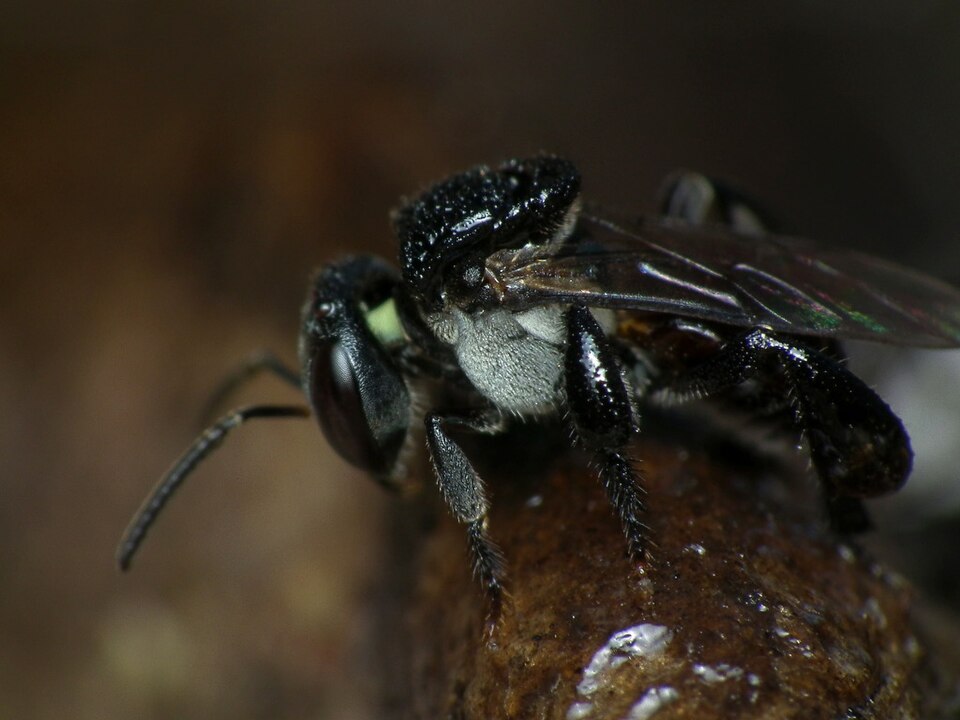
How big is it?
How long is it?
How big is Sugarbag bee compared to YOU?
Just maths in your browser. Nothing is saved or sent anywhere.
How fast is it?
Fun facts
Indigenous Australians eat its honey pots as bush tucker, and the bee is an important symbol in their cultures.
It builds its baby cells in a spiral shape, which no other bee in Australia does.
Guard bees stand at the nest door and keep out beetles, flies and other bees.
Females usually collect food within 500 metres of home, but some males fly up to 20 kilometres away.
It makes the biggest honey and pollen pots of all bees in its group.
Most asked questions about Sugarbag bee
?Do sugarbag bees make honey?
Yes. They store it in little pots called sugarbags, and people can eat it.
?How big is a sugarbag bee?
Only about 4 millimetres long, much smaller than a honey bee.
For bug experts
- Scientific name
- Tetragonula carbonaria
- Group
- Bees and bumblebees
- Family
- Apidae
- Classification
- Insecta > Hymenoptera > Apidae
- Lives on
- Australia and Oceania
- Also known as
- Bush bee
Where the facts come from
- Tetragonula carbonaria (Wikipedia, CC BY-SA 4.0): what it looks like, where it lives, what it eats, sizes and fun facts, retold in simple words.
- Picture by James Niland. CC BY 2.0, Wikimedia Commons. The round sticker of this bug is cut from the same picture.
If we got something wrong, sorry, we are bug fans, not a science journal. Tell us at [email protected] and we will fix it.
 Western honey bee
 Buff-tailed bumblebee
 Violet carpenter bee
 Giant honey bee
 Wallace's giant bee
 Himalayan giant honey bee
 Northern tree-dwelling funnel-web spider
 Kamehameha butterfly
 European spruce bark beetle
 Domino cockroach
 Japanese giant centipede
 Spined micrathena