
Tooth-thighed hoverfly
Tropidia scita

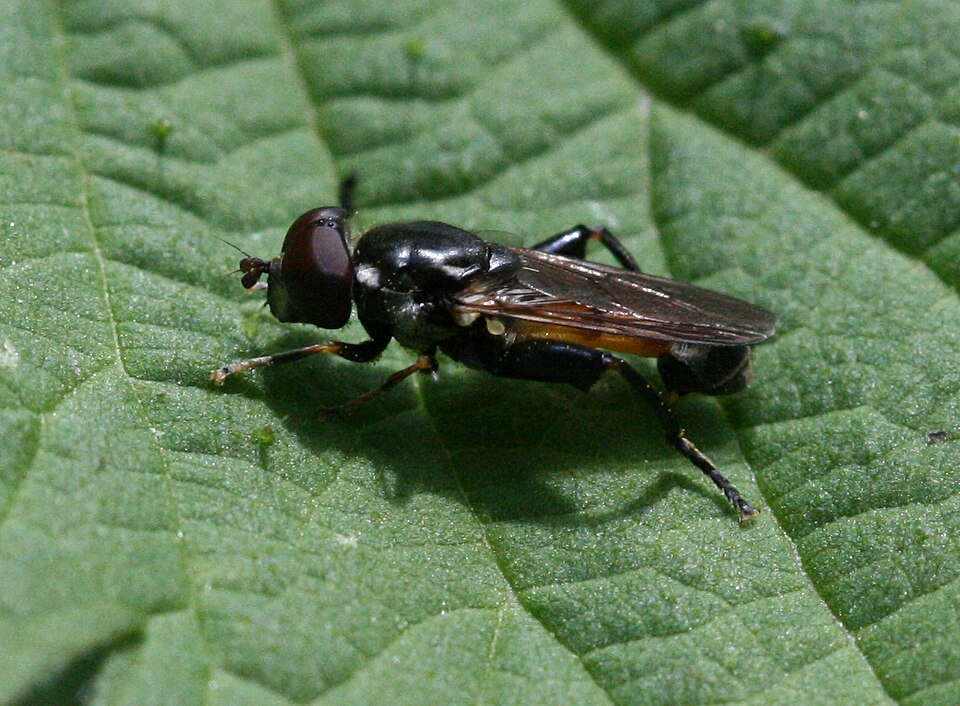
The tooth-thighed hoverfly is a common hoverfly of wet places like ponds and ditches. Its back is shiny black, and its tummy has yellow or orange bands. Its back legs have thick, curved thighs.
Lives in
Europe and Asia, from Ireland to Japan and Taiwan, around ponds, ditches and wetlands
Can it hurt you?
Harmless
Harmless. Hoverflies cannot sting or bite.
What does it eat?
The grown-ups visit flowers for nectar and pollen. The babies live at the base of cattail leaves by the water.
How fast is it?
A person walking about 5 km/h (3.1 mph)
A kid running fast about 13 km/h (8.1 mph)
Tooth-thighed hoverfly about 14 km/h (8.7 mph)
A grown-up on a bike about 25 km/h (16 mph)
cool stuff
Fun facts
1
Its babies have been found living inside the bottom of cattail leaves.
2
Its back thighs are swollen and curved.
3
It lives across a huge area, from Ireland all the way to Japan.
you asked
Most asked questions about Tooth-thighed hoverfly
?Is the tooth-thighed hoverfly dangerous?
No. It is a hoverfly and cannot sting.
?Where does the tooth-thighed hoverfly live?
Around ponds, ditches and wetlands in Europe and Asia.
For bug experts
- Scientific name
- Tropidia scita
- Group
- Flies and mosquitoes
- Family
- Syrphidae
- Classification
- Insecta > Diptera > Syrphidae
- Lives on
- Europe, Asia
Where the facts come from
- Tropidia scita (Wikipedia, CC BY-SA 4.0): what it looks like, where it lives, what it eats, sizes and fun facts, retold in simple words.
- Picture by Sandy Rae. CC BY-SA 3.0, Wikimedia Commons. The sticker of this bug is drawn from this picture.
If we got something wrong, sorry, we are bug fans, not a science journal. Tell us at [email protected] and we will fix it.
Bug Wiki honey jar For grown-ups: Bug Wiki is free, with no ads and no tracking. A small tip helps keep it online.Leave a tip Housefly
 New World screwworm fly
 Lovebug
 Tsetse fly
 Common fruit fly
 Asian tiger mosquito
 Brown drake
 Red marsh ladybird
 Black pennant
 Stream bluet
 Springwater dancer
 Whitewater rockmaster