
High eyelashed jumping spider
Phidippus mystaceus
Name means: “Mystaceus comes from the Greek word for moustache, because the females have a moustache of hairs.”

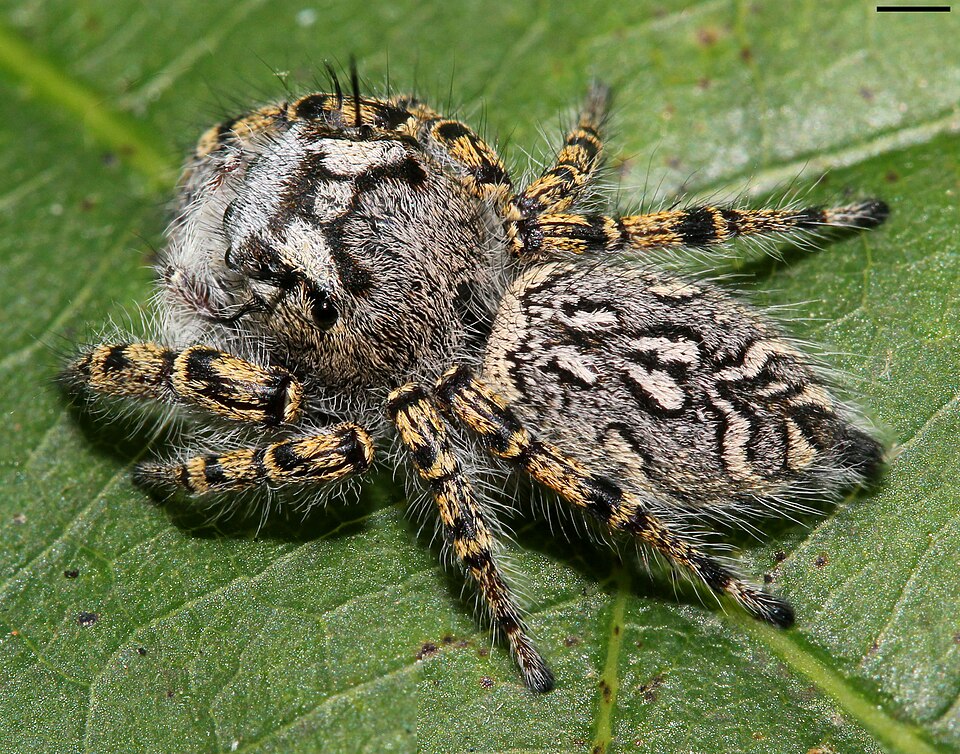
The high eyelashed jumping spider is a small jumping spider from North America. The females have a little moustache of hairs on their face. Above its eyes it has markings that look like donkey ears.
Fun fact: spiders are not insects. Insects have six legs, spiders have eight. Everyone calls them bugs anyway!
Lives in
North America
Length
1 cm (0.39 in)
femalesWhat does it eat?
Like other jumping spiders, it hunts small insects by sneaking up and pouncing.
How big is it?
How long is it?
💅small enough to sit on your fingernail🍚as long as 1.5 grains of rice in a row🍽️could run across a dinner table in 3.6 seconds⚡moves 28 times its own body length every second
How big is High eyelashed jumping spider compared to YOU?
Just maths in your browser. Nothing is saved or sent anywhere.
How fast is it?
A tortoise about 0.3 km/h (0.19 mph)
High eyelashed jumping spider about 1 km/h (0.62 mph)
A person walking about 5 km/h (3.1 mph)
A kid running fast about 13 km/h (8.1 mph)
cool stuff
Fun facts
1
Its scientific name mystaceus comes from an old Greek word for moustache.
2
An older name for it, asinarius, means donkey-like, because of the ear-shaped marks above its eyes.
3
A grown-up female is about 1 centimetre long.
you asked
Most asked questions about High eyelashed jumping spider
?Why does it have a moustache?
The females have a tuft of hairs on the face that looks like a moustache. That is where its scientific name comes from.
For bug experts
- Scientific name
- Phidippus mystaceus
- Group
- Spiders
- Family
- Salticidae
- Classification
- Arachnida > Araneae > Salticidae
- Lives on
- North America
Where the facts come from
- Phidippus mystaceus (Wikipedia, CC BY-SA 4.0): what it looks like, where it lives, what it eats, sizes and fun facts, retold in simple words.
- Picture by David Hill. CC BY 2.0, Wikimedia Commons. The sticker of this bug is drawn from this picture.
If we got something wrong, sorry, we are bug fans, not a science journal. Tell us at [email protected] and we will fix it.
Bug Wiki honey jar For grown-ups: Bug Wiki is free, with no ads and no tracking. A small tip helps keep it online.Leave a tip European garden spider
 Goliath birdeater
 Brown recluse
 Redback spider
 Yellow garden spider
 Bold jumping spider
 Common green-tenthredo
 Punctate flower chafer
 Sara orangetip
 Purple scale predator
 Black cocktail ant
 Metallic shield bug