
Stream bluet
Enallagma exsulans

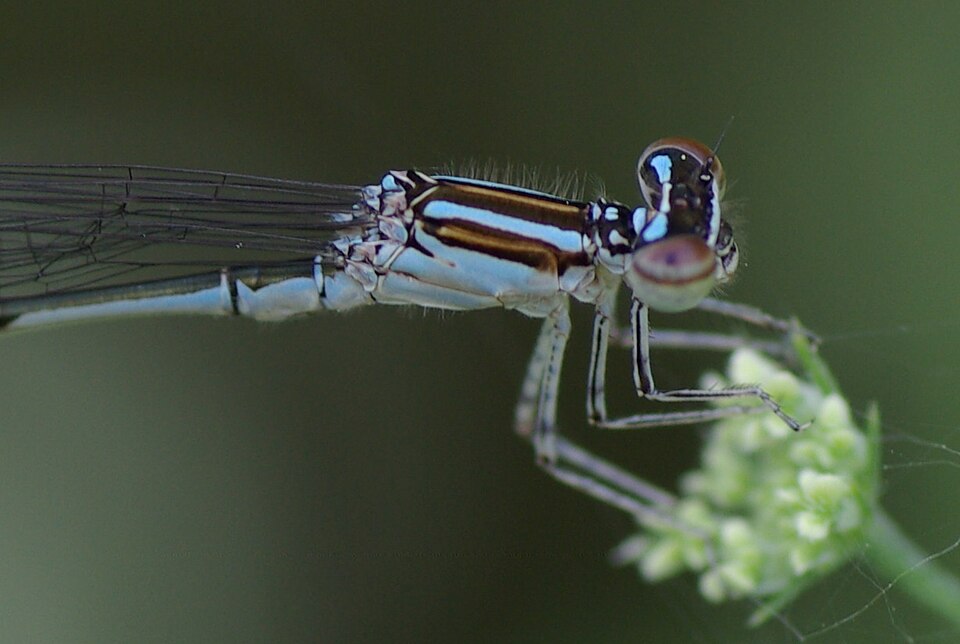
The stream bluet is a slim damselfly from North America. Most bluets like ponds and lakes, but this one loves rivers with moving water. Both males and females have a blue tip at the end of their tail.
Lives in
The eastern and central United States and southern Canada, along rivers
Length
2.9 to 3.7 cm (1.1 to 1.5 in)
Can it hurt you?
Harmless
Harmless. Damselflies do not sting.
What does it eat?
It catches tiny flying insects. Its young live in the river and hunt small water animals.
How big is it?
How long is it?
🍚as long as 6 grains of rice in a row⚽could fly across a whole football pitch in 38 seconds⚡moves 75 times its own body length every second
How big is Stream bluet compared to YOU?
Just maths in your browser. Nothing is saved or sent anywhere.
How fast is it?
A person walking about 5 km/h (3.1 mph)
Stream bluet about 10 km/h (6.2 mph)
A kid running fast about 13 km/h (8.1 mph)
A grown-up on a bike about 25 km/h (16 mph)
cool stuff
Fun facts
1
In most damselflies only the male has a blue tail tip, but in the stream bluet the female has one too.
2
Summer is the best time to look for it.
3
It looks a lot like another damselfly, the turquoise bluet.
you asked
Most asked questions about Stream bluet
?Where does the stream bluet live?
Along small and medium rivers in the United States and southern Canada.
?How big is the stream bluet?
It is about 29 to 37 millimetres long.
For bug experts
- Scientific name
- Enallagma exsulans
- Group
- Dragonflies and damselflies
- Family
- Coenagrionidae
- Classification
- Insecta > Odonata > Coenagrionidae
- Lives on
- North America
Where the facts come from
- Stream bluet (Wikipedia, CC BY-SA 4.0): what it looks like, where it lives, what it eats, sizes and fun facts, retold in simple words.
- Picture by Gaberlunzi (Richard Murphy). CC BY-SA 3.0, Wikimedia Commons. The sticker of this bug is drawn from this picture.
If we got something wrong, sorry, we are bug fans, not a science journal. Tell us at [email protected] and we will fix it.
Bug Wiki honey jar For grown-ups: Bug Wiki is free, with no ads and no tracking. A small tip helps keep it online.Leave a tip Emperor dragonfly
 Common whitetail
 Green darner
 Ebony jewelwing
 Globe skimmer
 Blue dasher
 Fringed diving beetle
 Short-tailed swallowtail
 Emergent mayfly
 Willow leaf beetle
 Stone spider
 Water veneer