
Siamese pointy-tailed millipede
Thyropygus allevatus
Eats: Leftovers and dead thingsCentipedes and millipedesRainforests and junglesNot an insect, but a bug cousin

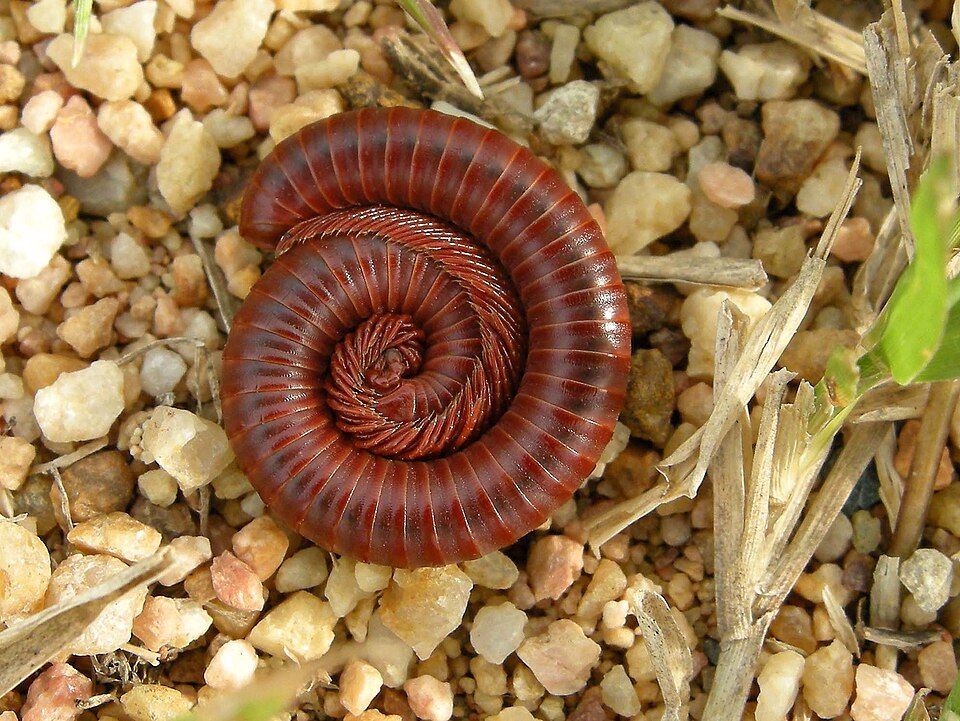
The Siamese pointy-tailed millipede is a big, round-backed millipede from Southeast Asia. Its long body is made of many rings, with lots of short legs underneath. Siam is the old name of Thailand.
Fun fact: this one is not an insect. Insects have six legs, and this cousin has many, many more.
Lives in
Sri Lanka, Thailand and Vietnam
Can it hurt you?
Harmless
Harmless. Like many millipedes it may leak a smelly juice if bothered, so wash your hands after touching it.
What does it eat?
Like other millipedes, it eats dead leaves and rotting plant bits on the forest floor.
How fast is it?
A garden snail about 0.05 km/h (0.03 mph)
Siamese pointy-tailed millipede about 0.2 km/h (0.12 mph)
A tortoise about 0.3 km/h (0.19 mph)
A person walking about 5 km/h (3.1 mph)
cool stuff
Fun facts
1
It belongs to a group of giant millipedes.
2
It lives in Sri Lanka, Thailand and Vietnam.
3
Millipedes have two pairs of legs on most rings of their body.
you asked
Most asked questions about Siamese pointy-tailed millipede
?Is the Siamese pointy-tailed millipede dangerous?
No. It is harmless, but wash your hands if you touch it.
?Where does the Siamese pointy-tailed millipede live?
In Sri Lanka, Thailand and Vietnam.
For bug experts
- Scientific name
- Thyropygus allevatus
- Named by
- Karsch, 1881
- Group
- Centipedes and millipedes
- Family
- Harpagophoridae
- Classification
- Diplopoda > Spirostreptida > Harpagophoridae
- Lives on
- Asia
Where the facts come from
- Thyropygus allevatus (Wikipedia, CC BY-SA 4.0): what it looks like, where it lives, what it eats, sizes and fun facts, retold in simple words.
- Picture by Len Worthington. CC BY-SA 2.0, Wikimedia Commons. The sticker of this bug is drawn from this picture.
If we got something wrong, sorry, we are bug fans, not a science journal. Tell us at [email protected] and we will fix it.
Bug Wiki honey jar For grown-ups: Bug Wiki is free, with no ads and no tracking. A small tip helps keep it online.Leave a tip Giant African millipede
 House centipede
 Amazonian giant centipede
 Vietnamese centipede
 Giant desert centipede
 Greenhouse millipede
 Electric ant
 Blue carpenter bee
 Titan beetle
 Wandering violin mantis
 Tumbu fly
 Brazilian salmon pink birdeater
.jpg)