
White-palped jumping spider
Euophrys frontalis
Name means: “frontalis comes from the Latin word for forehead, because of the markings on the front of its body”

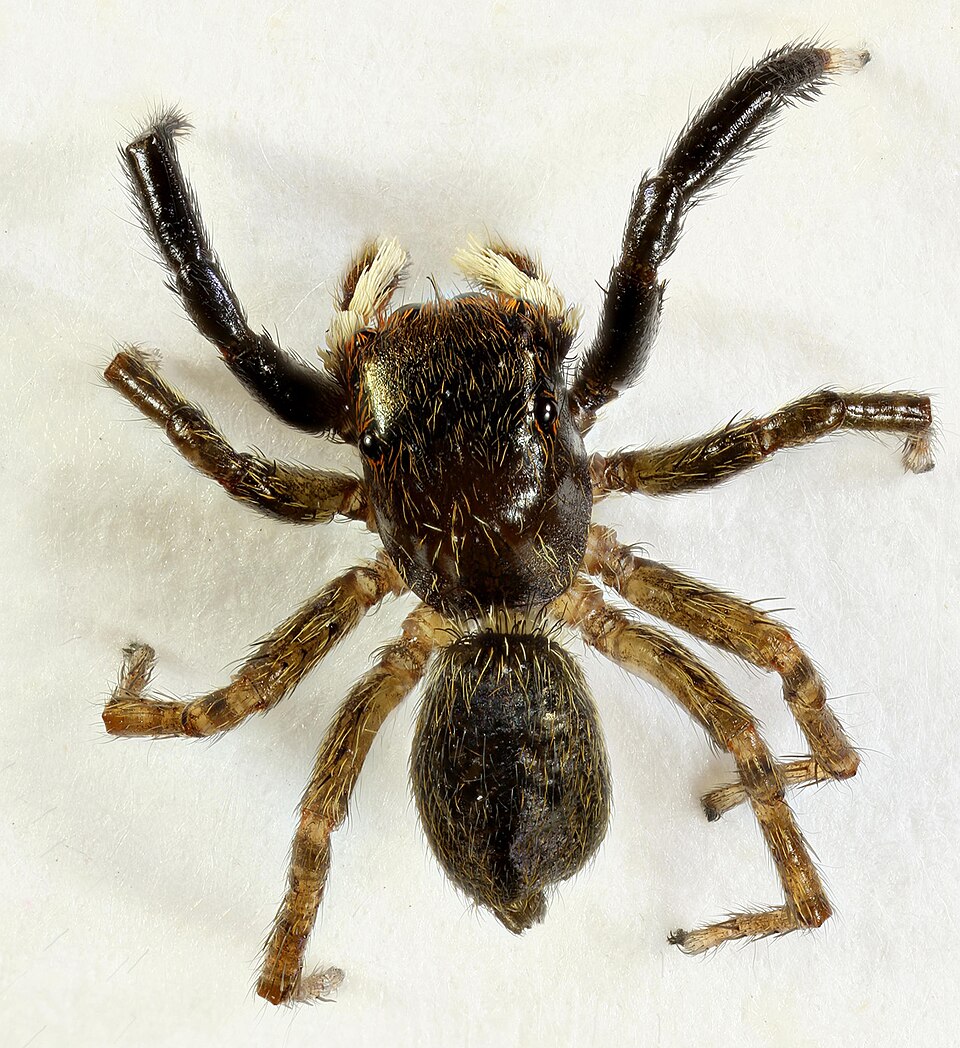
The white-palped jumping spider is a tiny spider that hunts with its eyes. It does not wait in a web. It sneaks up on its prey and pounces, like a little cat.
Fun fact: spiders are not insects. Insects have six legs, spiders have eight. Everyone calls them bugs anyway!
Lives in
Europe and Asia, from Britain all the way to Japan, in forests, gardens and parks
Length
3.4 to 4.4 mm (0.13 to 0.17 in)
What does it eat?
It hunts small insects on leaves, bushes and tree trunks, spotting them with its sharp eyes.
How big is it?
How long is it?
💅small enough to sit on your fingernail🍽️could run across a dinner table in 5.2 seconds⚡moves 44 times its own body length every second
How big is White-palped jumping spider compared to YOU?
Just maths in your browser. Nothing is saved or sent anywhere.
How fast is it?
A garden snail about 0.05 km/h (0.03 mph)
A tortoise about 0.3 km/h (0.19 mph)
White-palped jumping spider about 0.69 km/h (0.43 mph)
A person walking about 5 km/h (3.1 mph)
cool stuff
Fun facts
1
Its eyesight is excellent, and it uses it to find and stalk its food.
2
The male is darker than the female and can look almost black with a shiny shimmer around the eyes.
3
Males have thick dark front legs, which they wave in a special dance to win a female.
4
It was first described in 1802, more than 200 years ago.
you asked
Most asked questions about White-palped jumping spider
?Where does the white-palped jumping spider live?
In Europe and Asia, on low plants, bushes and tree trunks in forests, gardens and parks.
For bug experts
- Scientific name
- Euophrys frontalis
- Named by
- Walckenaer, 1802
- Group
- Spiders
- Family
- Salticidae
- Classification
- Arachnida > Araneae > Salticidae
- Lives on
- Europe, Asia
Where the facts come from
- Euophrys frontalis (Wikipedia, CC BY-SA 4.0): what it looks like, where it lives, what it eats, sizes and fun facts, retold in simple words.
- Picture by Janet Graham. CC BY 2.0, Wikimedia Commons. The sticker of this bug is drawn from this picture.
If we got something wrong, sorry, we are bug fans, not a science journal. Tell us at [email protected] and we will fix it.
Bug Wiki honey jar For grown-ups: Bug Wiki is free, with no ads and no tracking. A small tip helps keep it online.Leave a tip European garden spider
 Goliath birdeater
 Brown recluse
 Redback spider
 Yellow garden spider
 Bold jumping spider
 Death's-head hawk-moth
 Violet carpenter bee
 Large bee-fly
 Eastern yellowjacket
 Virginian tiger moth
 Large yellow underwing
.jpg)