
West coast laceweaver
Callobius severus

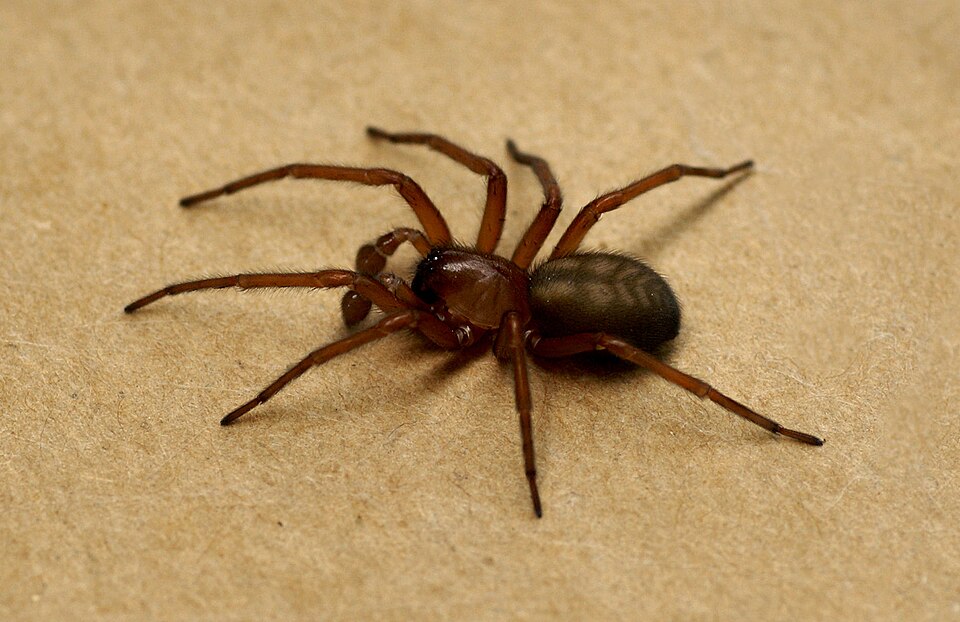
The west coast laceweaver is a brown spider with a grey, fuzzy tummy covered in paler spots in a mirror pattern. It lives in woods, but it also likes houses, sheds and other buildings. There it spins thin webs shaped like funnels.
Fun fact: spiders are not insects. Insects have six legs, spiders have eight. Everyone calls them bugs anyway!
Lives in
The Pacific Northwest of the United States and Canada, in woods and around houses
Length
1.9 cm (0.75 in)
What does it eat?
Like other spiders, it catches insects and other small creatures in its web.
How big is it?
How long is it?
🍚as long as 3 grains of rice in a row🍽️could run across a dinner table in 2.1 seconds⚡moves 25 times its own body length every second
How big is West coast laceweaver compared to YOU?
Just maths in your browser. Nothing is saved or sent anywhere.
How fast is it?
A tortoise about 0.3 km/h (0.19 mph)
West coast laceweaver about 1.7 km/h (1.1 mph)
A person walking about 5 km/h (3.1 mph)
A kid running fast about 13 km/h (8.1 mph)
cool stuff
Fun facts
1
It is one of the most common spiders in towns and houses in Washington state.
2
Females are usually bigger than males.
3
Males have big, long feelers at the front with knobs that stick out.
4
It moves into houses if no other animal has already taken the spot.
you asked
Most asked questions about West coast laceweaver
?How big is the west coast laceweaver?
About 2 centimetres long. Males are usually smaller than females.
For bug experts
- Scientific name
- Callobius severus
- Group
- Spiders
- Family
- Amaurobiidae
- Classification
- Arachnida > Araneae > Amaurobiidae
- Lives on
- North America
- Also known as
- Pacific hacklemesh weaver
Where the facts come from
- Callobius severus (Wikipedia, CC BY-SA 4.0): what it looks like, where it lives, what it eats, sizes and fun facts, retold in simple words.
- Picture by KirinX ( talk ). CC BY 3.0, Wikimedia Commons. The sticker of this bug is drawn from this picture.
If we got something wrong, sorry, we are bug fans, not a science journal. Tell us at [email protected] and we will fix it.
Bug Wiki honey jar For grown-ups: Bug Wiki is free, with no ads and no tracking. A small tip helps keep it online.Leave a tip European garden spider
 Goliath birdeater
 Brown recluse
 Redback spider
 Yellow garden spider
 Bold jumping spider
 Deathwatch beetle
 House cricket
 Kissing bug
 Sand fly
 Black carpet beetle
 Odorous house ant