
Lucerne moth
Nomophila nearctica

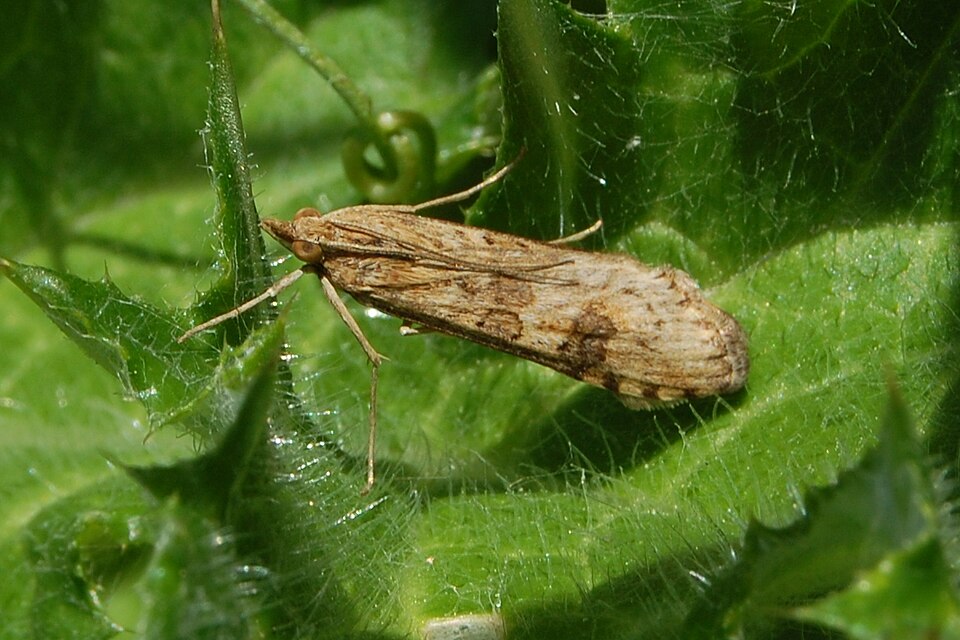
The lucerne moth is a common moth from the Americas. It has lots of names, because its caterpillars eat many garden and farm plants. They munch celery, clover, lucerne and grasses.
Lives in
From southern Canada through all of the United States to Mexico and South America
Wingspan
2.4 to 3.5 cm (0.94 to 1.4 in)
Can it hurt you?
Harmless
Harmless to people. It does not bite or sting.
What does it eat?
Its caterpillars eat celery, grasses, lucerne, clover and other low plants.
How big is it?
How wide are its wings?
🍚wings as wide as 6 grains of rice in a row⚽could fly across a whole football pitch in 29 seconds
How big is Lucerne moth compared to YOU?
Just maths in your browser. Nothing is saved or sent anywhere.
How fast is it?
A person walking about 5 km/h (3.1 mph)
A kid running fast about 13 km/h (8.1 mph)
Lucerne moth about 13 km/h (8.1 mph)
A grown-up on a bike about 25 km/h (16 mph)
cool stuff
Fun facts
1
Its wings are about 2.5 to 3.5 centimetres from tip to tip.
2
It flies for a long time each year, from April to November.
3
Lucerne is another name for alfalfa, one of the plants its caterpillars eat.
you asked
Most asked questions about Lucerne moth
?What does the lucerne moth eat?
Its caterpillars eat celery, grasses, clover, lucerne and other low plants.
?Is the lucerne moth harmful?
Not to people. It is a common moth of fields and gardens.
For bug experts
- Scientific name
- Nomophila nearctica
- Group
- Moths
- Family
- Crambidae
- Classification
- Insecta > Lepidoptera > Crambidae
- Lives on
- North America, South America
- Also known as
- Clover nomophila, False webworm, Celery stalkworm, American celery webworm
Where the facts come from
- Nomophila nearctica (Wikipedia, CC BY-SA 4.0): what it looks like, where it lives, what it eats, sizes and fun facts, retold in simple words.
- Picture by Eugene Zelenko. CC BY-SA 4.0, Wikimedia Commons. The sticker of this bug is drawn from this picture.
If we got something wrong, sorry, we are bug fans, not a science journal. Tell us at [email protected] and we will fix it.
Bug Wiki honey jar For grown-ups: Bug Wiki is free, with no ads and no tracking. A small tip helps keep it online.Leave a tip Atlas moth
 Luna moth
 Hummingbird hawk-moth
 Domestic silk moth
 Isabella tiger moth
 Polyphemus moth
 Black-veined white
 Hornworm parasitoid wasp
 Striped shield bug
 Australian bush fly
 Marbled white
 Black oil beetle