
Asian jumping mantis
Statilia maculata

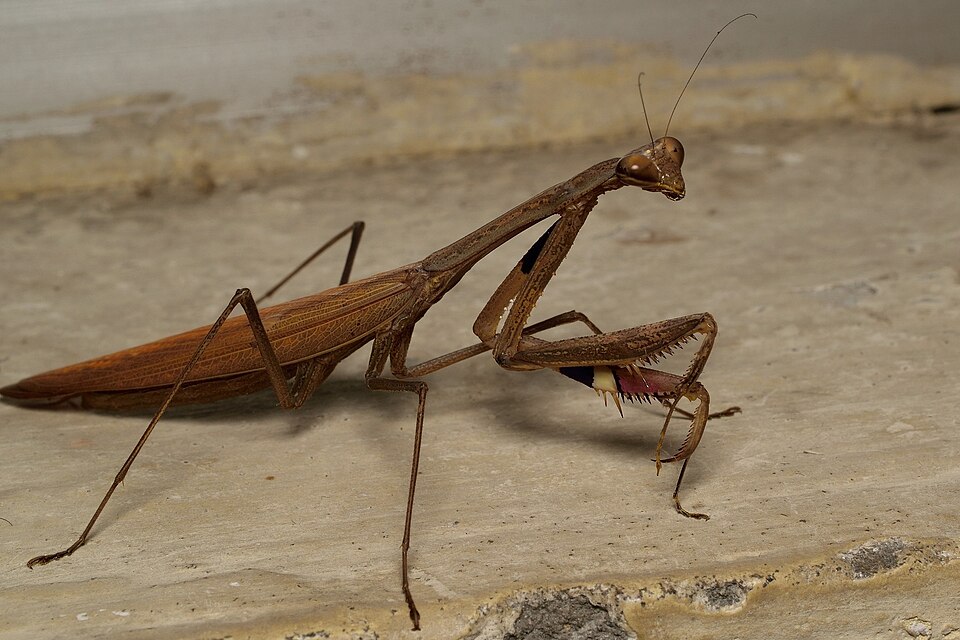
The Asian jumping mantis is a praying mantis from Asia. In Japanese and Korean its name means small mantis. Like all mantises it has strong front legs for grabbing insects.
Lives in
Asia, from India and Sri Lanka to China, Korea, Japan, Russia and New Guinea
Length
4 to 5.8 cm (1.6 to 2.3 in)
Can it hurt you?
Harmless
Harmless to people. It only hunts small insects.
What does it eat?
Like all mantises, it catches insects with its spiny front legs.
How big is it?
How long is it?
🍚as long as 10 grains of rice in a row🧱as long as 2 toy building bricks in a row🍽️could run across a dinner table in 3.7 seconds
How big is Asian jumping mantis compared to YOU?
Just maths in your browser. Nothing is saved or sent anywhere.
How fast is it?
A tortoise about 0.3 km/h (0.19 mph)
Asian jumping mantis about 0.98 km/h (0.61 mph)
A person walking about 5 km/h (3.1 mph)
A kid running fast about 13 km/h (8.1 mph)
cool stuff
Fun facts
1
Females are a bit bigger than males, up to about 6 centimetres long.
2
It was first described in 1784 by the Swedish scientist Carl Peter Thunberg.
3
In parts of Japan and China, people use its egg cases in old medicines.
4
In one area of Japan, people cook and eat it with sweet soy sauce.
you asked
Most asked questions about Asian jumping mantis
?Is the Asian jumping mantis dangerous?
No. It is harmless to people.
?How big is the Asian jumping mantis?
Males are 4 to 5 centimetres long and females 4.5 to almost 6 centimetres.
For bug experts
- Scientific name
- Statilia maculata
- Named by
- Thunberg, 1784
- Group
- Mantises
- Family
- Mantidae
- Classification
- Insecta > Mantodea > Mantidae
- Lives on
- Asia, Australia and Oceania
Where the facts come from
- Statilia maculata (Wikipedia, CC BY-SA 4.0): what it looks like, where it lives, what it eats, sizes and fun facts, retold in simple words.
- Picture by (c) Rohit, some rights reserved (CC BY-SA). CC BY-SA 4.0, Wikimedia Commons. The sticker of this bug is drawn from this picture.
If we got something wrong, sorry, we are bug fans, not a science journal. Tell us at [email protected] and we will fix it.
Bug Wiki honey jar For grown-ups: Bug Wiki is free, with no ads and no tracking. A small tip helps keep it online.Leave a tip European mantis
 Orchid mantis
 Chinese mantis
 Carolina mantis
 Conehead mantis
 Wandering violin mantis
 Androgeus swallowtail
 White-spotted sable
 Spring cankerworm moth
 Confused haploa moth
 Spanish snail
 Field cuckoo bumble bee