

Bug card No. 0836 of 1,500
Large-clawed scorpion
Scorpio maurus
Eats: Other bugs and small animalsScorpions, ticks and friendsDeserts and dry places8 legsNot an insect, but a bug cousin
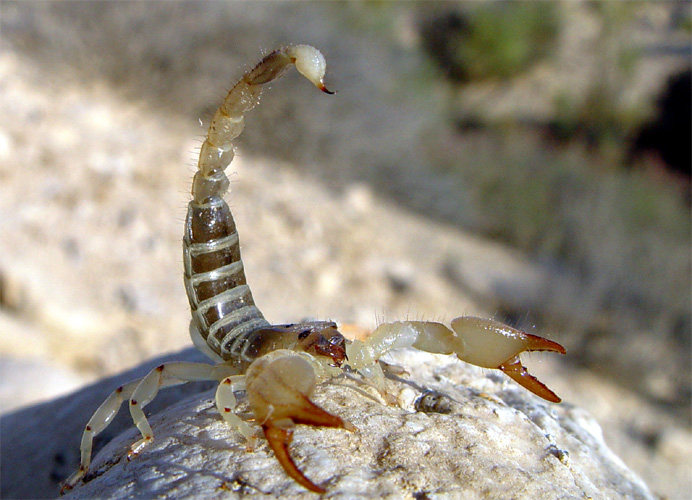
The large-clawed scorpion has a brown back and big, golden claws. It is a champion digger that makes very deep burrows in the desert sand. Deep down in its burrow, the sand stays cool and a little damp.
Fun fact: this one is not an insect. It is an arachnid with eight legs, a cousin of the spiders.
Lives in
North Africa and the Middle East, in deserts and sometimes thin woodland
Length
7.6 cm (3 in)
What does it eat?
Like other scorpions, it catches insects and other small creatures with its big claws.
How big is it?
How long is it?
🧱as long as 2.5 toy building bricks in a row🍽️could run across a dinner table in 1.6 seconds
How big is Large-clawed scorpion compared to YOU?
Just maths in your browser. Nothing is saved or sent anywhere.
How fast is it?
A tortoise about 0.3 km/h (0.19 mph)
Large-clawed scorpion about 2.3 km/h (1.4 mph)
A person walking about 5 km/h (3.1 mph)
A kid running fast about 13 km/h (8.1 mph)
cool stuff
Fun facts
1
Its burrows can be up to 1 metre deep, about as deep as a 6-year-old is tall.
2
There are many different types of this scorpion living in different places, and scientists have described 19 of them.
you asked
Most asked questions about Large-clawed scorpion
?How big is the large-clawed scorpion?
It is about 7.5 centimetres long.
?Where does the large-clawed scorpion live?
In deep burrows in the deserts of North Africa and the Middle East.
For bug experts
- Scientific name
- Scorpio maurus
- Named by
- Linnaeus, 1758
- Group
- Scorpions, ticks and friends
- Family
- Scorpionidae
- Classification
- Arachnida > Scorpiones > Scorpionidae
- Lives on
- Africa, Asia
- Also known as
- Israel golden scorpion, Zerachia scorpion
Where the facts come from
- Scorpio maurus (Wikipedia, CC BY-SA 4.0): what it looks like, where it lives, what it eats, sizes and fun facts, retold in simple words.
- Picture by Guy Haimovitch. CC BY-SA 3.0, Wikimedia Commons. The round sticker of this bug is cut from the same picture.
If we got something wrong, sorry, we are bug fans, not a science journal. Tell us at [email protected] and we will fix it.
 Emperor scorpion
 Lone star tick
 Deathstalker
 Itch mite
 Eyelash mite
 Deer tick
 Pinacate beetle
 Mexican redknee tarantula
 Orange baboon tarantula
 Wheel spider
 Tiger centipede
 Arctic woolly bear moth