

Paradoxides
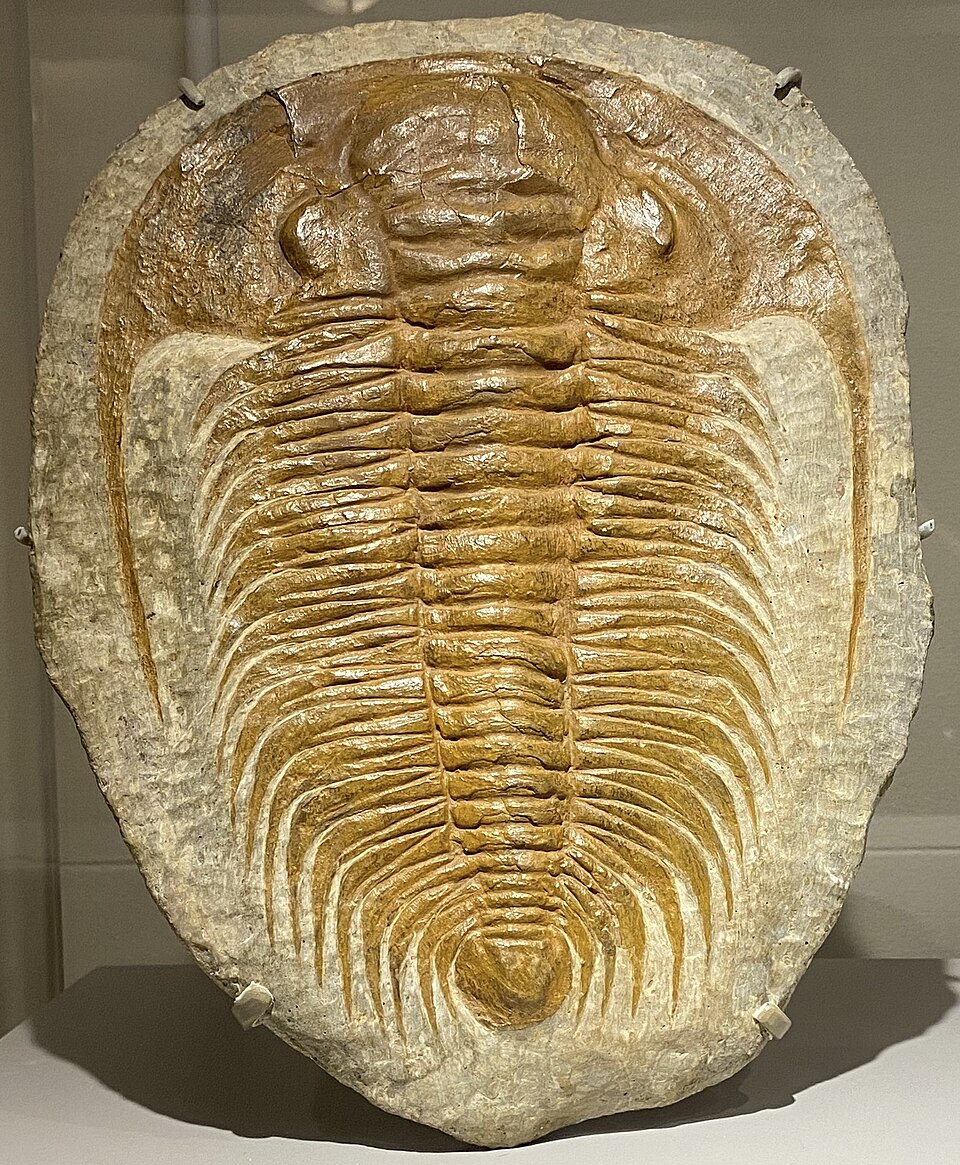
Paradoxides was a trilobite, an old sea creature with a hard, flat shell split into many parts. It had a round head with long, curved spines at the sides and lots of spiky segments down its back. It crawled on the sea floor more than 500 million years ago, long before there were any fish with jaws or dinosaurs.
When did it live?
How fast is it?
Fun facts
It was one of the biggest trilobites. The record fossil is 37 centimetres long, longer than a school ruler.
Its eyes were shaped like crescent moons and could see almost all the way around it, but only sideways, not up.
Its back was made of 19 to 21 segments, each with a long spine curving backwards.
To grow, it wriggled out of its old shell through the front, like taking off a jumper.
Its baby started out as a tiny disc with three pairs of spines around the edge.
Most asked questions about Paradoxides
?What is a trilobite?
A sea animal with a hard, jointed shell that lived hundreds of millions of years ago. It was a distant cousin of today's insects, spiders and crabs.
?How big was Paradoxides?
Large ones were very big for a trilobite. The record fossil is 37 centimetres long.
?When did Paradoxides live?
In the Middle Cambrian, about 509 to 497 million years ago, long before the dinosaurs.
For bug experts
- Scientific name
- Paradoxides
- Named by
- Brongniart, 1822
- Group
- Prehistoric giants
- Family
- Paradoxididae
- Classification
- Trilobita > Redlichiida > Paradoxididae
Where the facts come from
- Paradoxides (Wikipedia, CC BY-SA 4.0): what it looks like, where it lives, what it eats, sizes and fun facts, retold in simple words.
- Picture by Ryan Schwark. CC0, Wikimedia Commons. The round sticker of this bug is cut from the same picture.
If we got something wrong, sorry, we are bug fans, not a science journal. Tell us at [email protected] and we will fix it.
 Meganeura
 Anomalocaris
 Arthropleura
 Hallucigenia
 Opabinia
 Megarachne